"There comes a time in each life like a point of fulcrum. At that time you must accept yourself. It is not any more what you will become. It is what you are and always will be."-- John Fowles, The Magus

Showing posts with label books. Show all posts
Showing posts with label books. Show all posts
Saturday, October 19, 2013
A point of fulcrum

Sunday, February 3, 2013
2012: The year in reading
This is what I read in 2012. Lots of manga, some excellent time waster, quite a few gems. Among my favorite novels last year, Jean-Patrick Manchette's La position du tireur couché, Ian Tregillis' Bitter Seeds, Jonathan Franzen's Freedom, and Giampaolo Simi's La Notte alle mie spalle. Among the graphic novels, Craig Thompson's Habibi, and the Bakuman series.
The full list:

The full list:
| A Wrinkle in Time | Madeleine L'engle |
| Le Roi de Fer | Maurice Druon |
| Cat's Eye | Margaret Atwood |
| L'Ami De'Enfance De Maigret | Georges Simenon |
| La Position du tireur couché | Jean-Patrick Manchette |
| The Secret Garden | Frances Hodgson Burnett |
| N Is for Noose | Sue Grafton |
| O is for Outlaw | Sue Grafton |
| Bienvenue parmi nous | Eric Holder |
| Un Leonberger di nome Bruno ovvero cosa non si fa per un biscotto | Arianna Falconer |
| P is for Peril | Sue Grafton |
| Q is for Quarry | Sue Grafton |
| His Majesty's Dragon | Naomi Novik |
| DMZ Vol. 1 | Brian Wood |
| Black Powder War | Naomi Novik |
| Welcome to the NHK Volume 1 | Tatsuhiko Takimoto, Kendi Oiwa |
| Emma | Kaoru Mori |
| The Invention of Hugo Cabret | Brian Selznick |
| Emma | Kaoru Mori |
| Wasteland Book 1 | Christopher J. Mitten, Antony Johnston |
| Emma | Kaoru Mori |
| I Am the Cheese | Robert Cormier |
| Empire of Ivory: Temeraire Bk. 4 | Naomi Novik |
| Throne of Jade | Naomi, Novik |
| Victory of Eagles | Naomi Novik |
| Blue Heaven | C.J. Box |
| Town of Evening Calm, Country of Cherry Blossoms | Fumiyo Kouno |
| Diary of a Wimpy Kid - Dog Days: Book 4 | Jeff Kinney |
| Blood Rites | Jim Butcher |
| Freedom | Jonathan Franzen |
| Prima di sparire | Mauro Covacich |
| Un giorno verrò a lanciare sassi alla tua finestra | Claudia Durastanti |
| Les enfants du néant | Olivier Descosse |
| Bitter Seeds | Ian Tregillis |
| Wuthering Heights (Collins Classics) | Emily Brontë |
| Sandman Slim | Richard Kadrey |
| La ronde des innocents | Valentin Musso |
| Tongues of Serpents | Naomi Novik |
| The Dervish House | Ian Mcdonald |
| Punish the Sinners | John Saul |
| Diary of a Wimpy Kid: The Ugly Truth | Jeff Kinney |
| Okay for Now | Gary D. Schmidt |
| Il gioco degli specchi | Andrea Camilleri |
| Before I Go to Sleep | S J Watson |
| Blankets | Craig Thompson |
| Le passager | Jean-Christophe Grangé |
| Il mercante di libri maledetti | Marcello Simoni |
| All the Earth, Thrown to the Sky | Joe R. Lansdale |
| Reamde | Neal Stephenson |
| Habibi | Craig Thompson |
| Incidences | Philippe Djian |
| La valle delle donne lupo | Laura Pariani |
| La Forza del destino | Marco Vichi |
| Bakuman vol. 11 | Takeshi Obata, Tsugumi Ohba |
| La carta più alta | Marco Malvaldi |
| Bakuman vol. 12 | Takeshi Obata, Tsugumi Ohba |
| Bakuman | Tsugumi Ohba |
| Wild Thing | Josh Bazell |
| I'm Starved for You | Margaret Atwood |
| Crucible of Gold | Naomi Novik |
| L'appel de l'ange | Guillaume Musso |
| Bakuman, Vol. 10 | Tsugumi Ohba |
| Respiro corto | Massimo Carlotto |
| La legge della giungla | Enrico Brizzi |
| Invictus | Simone Sarasso |
| Tu sei il male | Roberto Costantini |
| The Drowned Cities | Paolo Bacigalupi |
| Ufficio di scollocamento | Simone Perotti, Paolo Ermani |
| L'été tous les chats s'ennuient | Philippe Georget |
| The Janus Affair | Pip Ballantine |
| Una lama di luce | Andrea Camilleri |
| Bakuman vol. 15 | Takeshi Obata, Tsugumi Ohba |
| The Perks of Being a Wallflower | Stephen Chbosky |
| San Miguel | T.C. Boyle |
| The Casual Vacancy | J.K. Rowling |
| The Coldest War | Ian Tregillis |
| La notte alle mie spalle | Giampaolo Simi |

Wednesday, December 5, 2012
Ho abbracciato James Ellroy 2: The Black Dahlia
Ho abbracciato James Ellroy un’altra volta (e ha pure abbracciato mia moglie, non senza qualche mia preoccupazione). Così si sono svolti i fatti: James Ellroy: The Black Dahlia | The Blog Around the Corner:


Saturday, September 29, 2012
Quote of the day
"[H]e was a man who for ten years had kept his mind filled with dark and heart-broken thinking. He had not been courageous; he had never tried to put any other thoughts in the place of the dark ones. He had wandered by blue lakes and thought them; he had lain on mountain-sides with sheets of deep blue gentians blooming all about him and flower breaths filling all the air and he had thought them."
--Frances Hodgson Burnett, The Secret Garden
Thursday, September 6, 2012
The way we read
Amazon is still looking forward -- and backwards, in the age of digital reading. Two man themes from today’s press conference. First, it focuses on service, not gadgets. While most of the commentators in the past year have been focused on the bogus paper-vs. digital debate, lamenting the restrictions of DRM, or complaining about the looks of the rectangular square plastic tablets, a lot was happening in the Kindleverse. Whispernet allowed us to download and read books almost everywhere on the planet, and to keep them in sync among our many devices. Library borrowing followed, bringing back the sharing dimension of traditional books while protecting copyright holders. The Amazon Digital Publishing platform allowed authors immediate access to the market, with royalties unheard of in book publishing history.
Today they added a new dimension, with serialization. Not only authors will be able to sell one chapter at a time, but Kindle will automatically aggregate them into the larger opus. Not by chance Amazon is experimenting with the free distribution of some Dickens classics, the golden era of serialization. But what they promise is more, and along the line of what Neal Stephenson, Greg Bear et al. have tried (http://mongoliad.com/): not only serialization, but active discussion, opening up the avenue for author-reader interaction and participative reading. The possibilities are endless (and perhaps scary too, if one takes Stephen King’s “Misery” a little too seriously). So while others might be focusing on the bells and whistles, device resolutions and gaming possibilities, as a reader I salute this new effort to bring reading out of the static, publishing-industry-controlled twentieth century model… and getting back some of the more intriguing literary possibilities from centuries past.
And speaking of serialization:
And speaking of serialization:
Wednesday, March 14, 2012
CJ Box: Blue Heaven Italian Release Interview
 CJ Box "Blue Heaven" has just been released in the Italian edition as Un angolo di paradiso (Piemme linea rossa)
 . This is the first of his work to appear on the Italian market. A big Thank You to CJ for having the patience to respond to our questions, and best of luck on the Italian market!. The Italian version of this interview is here.
Q.: Please introduce yourself for your new Italian readers
CJ: (From my bio):
I'm a New York Times bestselling author of thirteen novels including the Joe Pickett series. I won the Edgar Alan Poe Award for Best Novel (BLUE HEAVEN, 2009) as well as the Anthony Award, Prix Calibre 38 (France), the Macavity Award, the Gumshoe Award, the Barry Award, and the 2010 Mountains & Plains Independent Booksellers Association Award for fiction. My short stories have been featured in America’s Best Mystery Stories of 2006 and limited-edition printings. 2008 novel BLOOD TRAIL was nominated for the International IMPAC Dublin (Ireland) Literary Award. The novels have been translated into 25 languages. BLUE HEAVEN and NOWHERE TO RUN have been optioned for film.
I'm a Wyoming native and have worked as a ranch hand, surveyor, fishing guide, a small town newspaper reporter and editor. I've hunted, fished, hiked, ridden, and skied throughout Wyoming and the Mountain West. I live in Wyoming. I'm very excited the novels will FINALLY be published in Italy. I've been to the country several times and love it.
Q.: Blue Heaven has some Really Bad cops, not just the corrupt kind, but the dark, violent, power drunk kind, with loud echoes of James Ellroy. Like many, I suspect, I first heard about cop retirement communities at the time of the OJ Simpson trial. How long has this novel been in gestation? How much is it inspired by real facts?
CJ: I was at a book signing in Los Angeles four years before I wrote BLUE HEAVEN when a member of the LAPD came to the signing. He mentioned that many of his fellow cops had retired and had moved to "Blue Heaven." I hadn't heard the term before so I followed up with him. I was fascinated by the concept of a thousand big-city cops moving to a very rural section of Idaho. I figured if there were a thousand ex-cops, a few of them were probably bad people. I flew to North Idaho and interviewed locals and a few of the ex-cops, and the story developed from there.
Q.: This is true of all your work, I think, but Blue Heaven in particular reads sometimes like a modern western. How important is the myth of the west for you?
CJ: I was born in the west and live there, and the myth of the west is all around. I don't really think about writing modern westerns, but I know that's how they seem to come out. In the U.S., the western is our history and culture and it defined our sense of self. A lone good man trying to do the right thing against power and corruption is a story worth retelling time and time again.
Q.: In particular, reading Blue Heaven Jess Rawlings reminded me of the “Brave Cowboy” Jack Buns. What do you think of Ed Abbey?
I'm a fan of Edward Abbey and I read the novel in college. It probably got into my blood.
Q.: Self reliance, solidarity in small community, distrust of government intrusion and bureaucracy are common themes in your books, yet your heroes (from Joe Pickett to Villatoro in Blue Heaven) are still devoted public servants. Does this represent for you the cultural dilemma of the West?
CJ: Yes, one of them. And like you asked earlier, it goes back to the western themes of a sheriff or lawman up against powerful forces outside the law. Sometimes, though, it's hard to justify who is good and who is bad, and I try not to make the answer too simplistic.
Q.: Much in the same way, your heroes often struggle to find a compromise between the ways of the past and the inevitable change in Blue Heaven brought in by resettling and development, or state politics like in Cold Wind. Joe Pickett struggles to reconcile nature preservation, hunting and recreation in nature. Do you think this compromise is possible?
CJ: Yes I do, although the struggle to get there isn't easy. In my books I try to present a balanced portrayal of many controversial issues. My hope is readers on both sides of the issue may see that there is another side and perhaps the other side isn't completely unreasonable or evil. I've had readers tell me their opinion of some controversies changed -- or was softened -- by being exposed to the other side. It's rewarding when that happens.
Q.: How much of Joe Pickett is there in you?
A little, certainly. I have daughters and a wife and I'm very devoted to them. But Joe Pickett is a fictional character and I'm not.
Q.: Big oil (Big gas? Fracking?) might change the face of your home state. Will Joe Pickett take them on?
CJ: I explored aspects of this issue in TROPHY HUNT and BELOW ZERO, but I'm sure it will be explored more in future novels. It's the classic dilemma: jobs and development set against shrinking communities and an older economy of agriculture and tradition. There are benefits and threats depending on which way it goes. There is a reasonable middle ground, I hope.
Q.: How do you divide your time? Do you intentionally take a break between episodes of the Joe Pickett series or do you just do that to follow up on ideas that do not fit in the saga?
CJ: Some stories and themes simply can't be Joe Pickett books, so that's why I write stand-alones as well. Plus, I know a series of twelve books can be daunting to a first-time reader and they may want to see what kind of novels I write by trying a stand-alone first. I love to do both, and I plan to continue to write both the series and stand-alone books.
Q.: Can you tell us something about your evolution as a writer?
It took twenty years to get a book published, and when it finally happened I felt unleashed. I still feel that way. I love to explore the themes and issues I write about, and I'm very grateful the books have been embraced all over the world.
Q.: Your 3 favorite books in the thriller/mystery/noir genre?
CJ: This is an impossible question to answer and sure to get me into trouble. How about three favorite authors instead?
1. Michael Connelly
2. Denise Mina
3. John Sandford
Q.: Your 3 favorite books in any genre?
CJ:
1. Catch-22, by Joseph Heller
2. The Rise of Theodore Roosevelt, by Edmund Morris
3. The novels of Thomas McGuane
Q.: What’s next for CJ Box?
I just finished the first draft for a new stand-alone novel called THE HIGHWAY. It's about a long-haul truck driver who is a serial killer. It scares me to death. Next month, my twelfth Joe Pickett novel will be out. It's called FORCE OF NATURE, and it's about Joe Pickett's outlaw friend Nate Romanowski. I think it's a very good one.
Sunday, March 11, 2012
Wild Thing


"When you can dump a hundred and seventy million barrels of crude into the Gulf of Mexico and take a write-off on the cleanup, cost-efficiency doesn’t really enter into it.”--John Bazell, Wild Thing
Friday, December 16, 2011
Natale in Noir, One Year Anniversary!
Natale in Noir rappresenta per noi un primo passo. Ed è un passo che stanno compiendo in molti, molto più bravi di noi. Ma siamo convinti che questa transizione rappresenti un tentativo di risolvere una volta per tutte il dualismo scrittori-lettori, l’oligopolio degli editori, le barriere invisibili che separano consumatori e produttori di cultura. Un micro-passo verso l’ideale di comunità di scrittori e lettori, perché ognuno di noi consciamente o no ricopre entrambi i ruoli. Comunità che si aggregano attorno a un’idea, a un genere, a un comune sentire, e che insieme producono e consumano prodotti culturali.
Questo è lo scopo di questo primo, seppur limitatissimo tentativo nato attorno alla comunità virtuale di Angolonero, con persone che si incontrano pur vivendo agli antipodi e collaborano alla costruzione di qualcosa che sia fruibile, sforzo comune: un prodotto libero sia nell’accesso che nell’acquisizione. Natale in Noir è anche un prodotto multimediale, ma non nell’interpretazione grossolana del futuro del libro a metà tra il videogame e il cartone animato, dove la parola scritta scompare a favore di altri formati.

Invece pensiamo che la parola scritta sia e rimanga centrale nel suo potere di trasportare il lettore in universo parallelo, guidato dalla mano dello scrittore ma ne completa l’opera, apportandovi il proprio bagaglio d’immaginario personale. La multimedialità (o meglio multimodalità) emerge piuttosto nei nuovi modelli di fruizione della parola scritta: sugli schermi di uno smartphone, piuttosto che su di un eReader, una tablet, un PC o semplicemente su carta tramite Print On Demand. Proprio per quello vogliamo cominciare questa esperienza con una raccolta di narrativa “in pillole” che speriamo adatta e godibile attraverso vari media.
Happy Holidays!Santa Barbara, California, Dicembre 2010
Wednesday, November 16, 2011
Notes from a frustrated 1Q84 reader (*spoilers*)
Dear Murakami-sensei,
I sorely miss the enigmatic characters of Dance Dance Dance or The Windup Bird Chronicles. Tengo and Aomame, instead, keep telling their readers about every little thought and feeling, ad nauseam. I find the stream of consciousness italics annoying and redundant, as I had found them in Kafka on the Beach. Why are you dumbing down your own work? It might have been (almost) tolerable if this was published feuilleton-style, one chapter at a time, and the readers needed to be constantly reminded what happened three pages earlier.
Maybe it's because of the school retrospectives that come up throughout the novel, but it almost looks like you are writing one of those encyclopedic manga. A good one, nonetheless but still a manga, rather Nobel-prize candidate work.

The two moons appear in the night sky: things are starting to get interesting, but still in a manga sort of way.
I suspect the translators keep rendering futon (布団) as "sofa" rather than as bedroll, or simply futon (duh!). Very annoying, if nothing else because I suspect they might "adapt" and/or equivocate plenty of other things
The frequent repetitions in the text are puzzling. I keep looking at them like they were minimalist musings, hoping to spot inconsistencies as I move along, something that might resonate with the unstable reality at the basis of the novel. But I just finds repetitions.
Tengo instant shrimp recipe: book 2, chapter 7: He put the sliced celery and mushrooms into the frying pan. Turning the gas flame up to high and lightly jogging the pan, he carefully stirred the contents with a bamboo spatula, adding a sprinkle of salt and pepper. When the vegetables were just beginning to cook, he tossed the drained shrimp into the pan. After adding another dose of salt and pepper to the whole thing, he poured in a small glass of sake. Then a dash of soy sauce and finally a scattering of Chinese parsley. Thank you Murakami-sensei!
I'll tell you what: bold characters in narrative should be abolished. If the text itself does not lend emphasis to the story, graphic tricks won't help. And they sure didn’t help here.
I get to the last page, and I wonder: was it worth it? I'm still undecided. There are signs of greatness, but diluted in a bloated, repetitive narrative. Unless the translation was wildly off the mark and missed ambiguities and (self) deception, I found the stream-of-consciousness parts completely useless and redundant, explaining over and over what had no need to be explained. There are great tragic figures, like Ushikawa. I loved the idea, hinted to throughout the novel by the literary coincidences and by Aomame in the finale, that Tengo Kanawa is actually writing the novel in which he is co-protagonist, the very one the readers have in their hands.
But were three volumes necessary? Do the literary qualities of the end result surpass similar "genre" literature? I would not be so sure about that.
Dear Murakami-sensei: next time send me the manuscript in advance, I'll volunteer delete all the italics and bolds, and we shall pair it down your work to one actually good volume.
Thank you for listening!
Your faithful reader
Friday, May 20, 2011
John Sayles reading A Moment in the Sun
John Sayles, earlier tonight at Chaucer's Books, read a chapter from his new novel, A Moment in the Sun . He also talked about writing and research, finding the right rhythm in character voices, and shooting movies in the Philippines.
 . He also talked about writing and research, finding the right rhythm in character voices, and shooting movies in the Philippines.
Monday, April 18, 2011
C'est Nickel!
If John Bazell and Joe Lansdale had a literary love child, he would probably look a lot like the self-reliant protagonist of Nickel Plated. The explosive setup is an attention-grabber from page one, and might appeal to a larger audience than teens. Aric Davis reinvents the YA boy novel with a gripping, no-holds-barred adventure that goes beyond the conventions of the genre: a hard boiled noir for teens, dealing with all but easy subject matter.
Sure, the book is far from perfect: writing a noir for YA is like walking on a tightrope: how can you still surprise the (young and older adult) readers and still have the main character be a kid? Nickel is perhaps a little too streetwise, but still more credible than any chaste vampire I read about.
Like my last year's favorite, Bacigalupi's Ship Breaker , Nickel Plated dares to dare, delving with unpleasant scenarios and violent conflict. But Aric Davis reminds us also that our present times can be as gritty and scary as any invented dystopia to come...
, Nickel Plated dares to dare, delving with unpleasant scenarios and violent conflict. But Aric Davis reminds us also that our present times can be as gritty and scary as any invented dystopia to come...Sunday, March 20, 2011
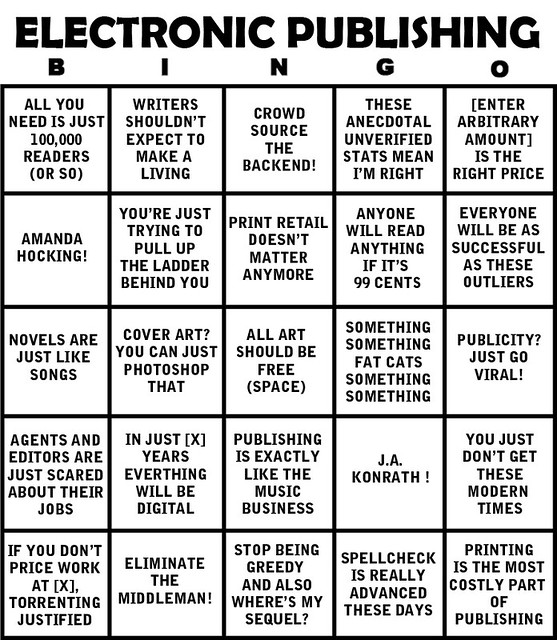
John Scalzi preempts any further discussion of ebook publishing :)
This convinced me I have nothing useful to add to the discussion
The Electronic Publishing Bingo Card
(Click to see a larger version)
Sunday, February 27, 2011
Top of the Book Chain
TCB gave a great reading today in front of a packed standing place only crowd at the Santa Barbara Museum of Art. After a short bio for the benefit of the two or three newbies who might have been in the audience, he read a the Dave Lajoy-Alma confrontation at the Museum of Natural History, an extract from chapter 2 of When the Killing's Done.
He then proceeded to bring down the house with laughter reading the hilarious Top of the Food Chain, a thematically related story (from "Without a Hero" and the book formerly known as "Stories," which allegedly will soon be re-baptized "Stories, Volume 1", and possibly illegally reproduced here).
Q&A included the evergreen "at what time do you write," something all aspiring writers seem to be obsessed with.
Signing followed, and I'm always amazed by our favorite author's kind disposition, sense of humor and overall resilience in the face of assailing crowds.

He then proceeded to bring down the house with laughter reading the hilarious Top of the Food Chain, a thematically related story (from "Without a Hero" and the book formerly known as "Stories," which allegedly will soon be re-baptized "Stories, Volume 1", and possibly illegally reproduced here).
Q&A included the evergreen "at what time do you write," something all aspiring writers seem to be obsessed with.
Signing followed, and I'm always amazed by our favorite author's kind disposition, sense of humor and overall resilience in the face of assailing crowds.
Tuesday, February 22, 2011

Tuesday, February 8, 2011
Among the bibliotropes
Amazon.com: Among Others (9780765321534): Jo Walton: Books
Non-bibliotropes might find this a lot less interesting. Yes, it's coming of age, and light fantasy, until the very end confounded by the narrator's personal obsessions and, perhaps, coping strategy for the pain she has to endure. But I wonder what the book will feel like to those for whom lots of the narrative will be drowned in a list of names, titles and characters they never heard of. All I can say is, I feel sorry for you :)
“Bibliotropic,” Hugh said. “Like sunflowers are heliotropic, they naturally turn towards the sun. We naturally turn towards the bookshop.”If you are more or less Jo Walton's age, and you were discovering what are now SF classics, you will enjoy this. I am a little younger, but given the translation lag I was subject to living in a non-English-reading country, I have lived some of these moments at the same age of the main character: the disappointment for the then new Heinlein, the surprise of the Hitchhiker's Guide...
Non-bibliotropes might find this a lot less interesting. Yes, it's coming of age, and light fantasy, until the very end confounded by the narrator's personal obsessions and, perhaps, coping strategy for the pain she has to endure. But I wonder what the book will feel like to those for whom lots of the narrative will be drowned in a list of names, titles and characters they never heard of. All I can say is, I feel sorry for you :)
Monday, January 24, 2011
Sunday, July 3, 2005
The Death of the American Editor

 "I Am Charlotte Simmons" is ripe full of amusing hits and misses. In a good segue to the 80s Bonfire of Vanities, Wolfe revisits the themes of shame, the dangers and pitfalls of the overconfident society. Yet as an expose of contemporary college life, the novel falls somewhat short, neither dipping into the real drama of well known problems (drugs, mental illness, nor painting a realistic picture of the class struggle behind the concept of College Academics. Aside from the basketball buffoons, there is for instance no credible portrait of minorities in the imaginary DuPont College, who according to research are the ones doing most of the study while the rich white kids use their college years as a platform of socialization into their future elite status. The device Wolfe employs, the tragically misplaced glamour of a famous academic institution from the point of view of a high school prodigy from the Blue Ridge Mountains, is in the end quite ineffective and leaves the reader with a sour aftertaste. The real struggle is elsewhere, this is the insignificant exception to the rules of class struggle. Wolfe also completely misses the mark making physical prowess rather than "cool" status the central male attainment goal. I have been living in a college community for 15 years, and seen fights at drunken parties, but it's hardly something anyone of the parties involved would be proud of or admired for after being bailed out of county jail the following morning. The imaginary wild west of DuPont is indeed a not too subtle flight of fancy possibly built for the Hollywood version of this sorry melodrama.
But what really leaves the reader appalled is the incredible amount of redundancy throughout the book. Whenever one anecdote would be sufficient to make a point, Wolfe uses two, sometimes one more later in the book where he is picking up the threads from a plot left unresolved. Repetition is the key, with cute inventions like "fuck patois" or "conversational nugget" (also a self-citation from the Bonfire) reintroduced and repeated over and over the interminable feuilleton.
Maybe the novel was intended for a public suffering from Alzheimer Disease? If so, while appreciate the noble intentions, I regret the lack of a warning label for the rest of us. Or possibly, this is a result of stinging together a bunch of over-researched episodes, without anyone really giving it more than a quick read-through. What happened to the concept of editing, or that "less is more" in literature? One has to regret Ellis' "Less Than Zero", which definitely got to the point so much more effectively and, above all, concisely. How many times can one remind the readers of an obvious point before forcing them to toss aside the massive and unwieldy hardcover? If all this was not enough the temporality or at least the succession of events is, to say the least, strained. Little childish "teasers" are inserted in chapters to remind the reader (i.e., that moron of a reader) of subplots evolving, desperately trying to get everything in sync for the predictable climax.
All this could have been easily fixed. So why wasn't it? Is this really the result of a team of researchers or at least creative writing students patching together a feuilleton? That's definitely how it feels like. With all its satire about the rising age of the idiot in our prestigious colleges, Mr. Wolfe has provided that very constituency with good, fun, and above all easy reading.
Subscribe to:
Posts (Atom)